

SITES Denmark; A new project supporting ACTRIS-DK
Published: 16, September, 2026
SITES Denmark; A new project supporting ACTRIS-DK
By: Henrik Skov, NFP and national delegate for ACTRIS Denmark, professor and head of Villum Research Station
Last Friday, we held the kick-off meeting for the project SITES Denmark (see Figure 1). The project is inspired by a similar Swedish initiative. SITES Denmark is a joint effort between the Danish contributions to four ESFRI research infrastructure projects: ACTRIS (Aerosol, Clouds and Trace Gases Research Infrastructure), ICOS (Integrated Carbon Observation System), eLTER (Integrated European Long-Term Ecosystem, Critical Zone and Socio-Ecological Research), and AnaEE (Analysis and Experimentation on Ecosystems).
The ultimate goal of SITES Denmark is to facilitate interdisciplinary research in the functioning of our natural and managed ecosystems and environment as a whole, strengthening the capacity of our society to address important environmental risks, such as climate change, environmental pollution, land use and management, and biodiversity loss. SITES Denmark will establish an integrated service portfolio with physical and virtual access provision for multiple research communities as well as industry users. SITES Denmark will provide easy access to complementary and interdisciplinary cutting-edge research infrastructures, including long-term ecosystem and atmospheric observatories, experimental facilities, and a new data access infrastructure.
Regarding ACTRIS, SITES Denmark will strengthen activities at Villum Research Station, and at the Risø station the ACTRIS activities will be co-located with a new ICOS station. To further enhance interdisciplinary capacity, a new ACTRIS mobile platform will be constructed and used to conduct measurements in various natural and agricultural environments.
These plans and the activities already underway ensure funding for ACTRIS Denmark for the next five years and make it possible for us to finally apply for ACTRIS labelling of our two observatory platforms.
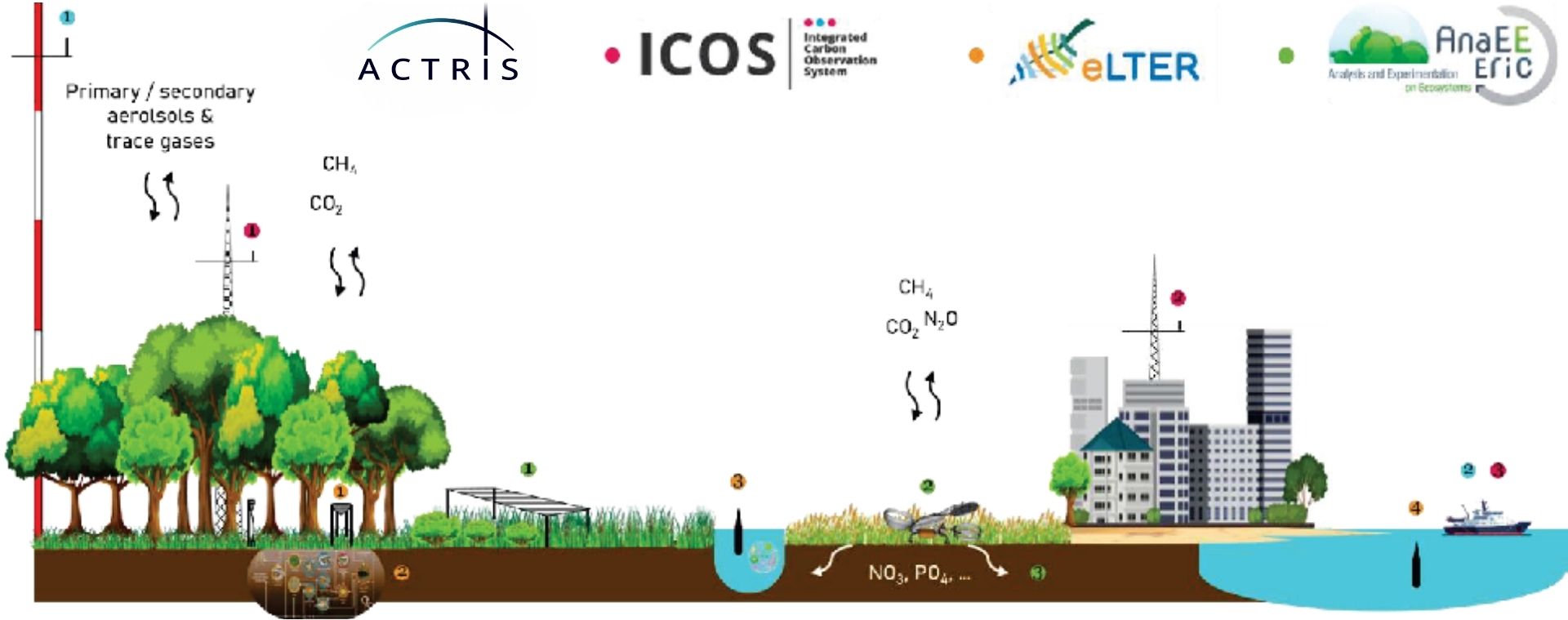
Figure 1 illustrates how SITES Denmark integrates environmental research infrastructures across multiple scientific fields and major ecosystem types in Denmark and Greenland—including agricultural land, forests, grasslands/shrublands, lakes and streams, urban areas, oceans, and the Arctic.