

One Year of Continuous ACTRIS Measurements at Invercargill, New Zealand
Published: 24, September, 2026
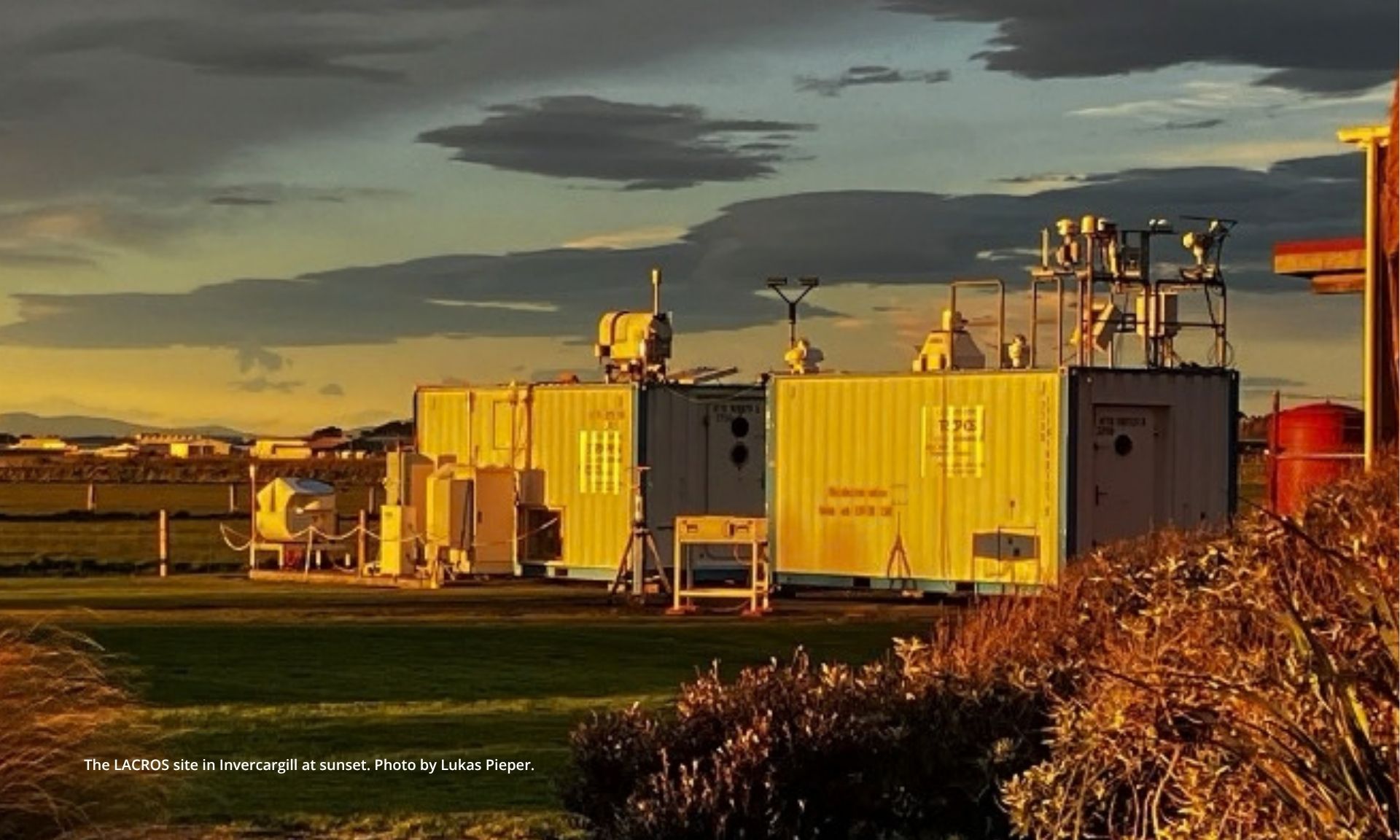
On 24th of August 2026, an important milestone was reached with the ACTRIS measurements in Invercargill, Aotearoa New Zealand: the goSouth-2 campaign reached its first anniversary with almost no data gaps! This provides the ACTRIS community with a unique cloud and aerosol dataset of a complete annual cycle in the Southern Ocean region. Core measurements at Invercargill are obtained with the mobile exploratory platform “Leipzig Aerosol and Cloud Remote Observations System” (LACROS) of TROPOS, which provides full Aerosol and Cloud Remote Sensing (ARS, CRS) capabilities, with additional contributions by in-situ observations of the aerosol number size distribution, as well as cloud condensation and ice nuclei concentrations. The dataset is topped by 2 radiosonde launches per day which are provided regularly by the MetService New Zealand that is operating at the same site. Over the year, the TROPOS team has captured a wide range of atmospheric conditions, including storms, frequent warm rain events (rainfall produced by clouds that do not contain ice), Australian wildfire smoke reaching the site, insects that travelled over long distances, and detailed observations of the local boundary layer.
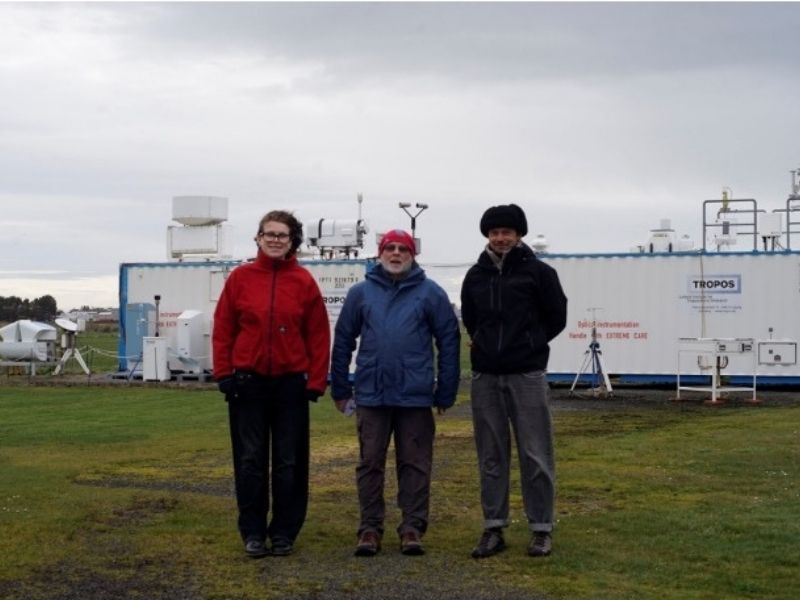
From left to right: Freya Coulson, Guy Coulson and Lukas Pieper in front of the LACROS measurement site. Photo by Lukas Pieper.
The one-year anniversary coincided with a visit of TROPOS Phd student Lukas Pieper for conducting important maintenance work. For the tasks to be completed, he received welcomed support by Freya Coulson, research assistant at the Air Quality Collective and chemical engineering student at the University of Auckland, and Dr. Guy Coulson, director of The Air Quality Collective and former principal air quality scientist at New Zealand's National Institute of Water and Atmospheric Research (NIWA). Freya also collected the Ice Nucleating Particle filter samples gathered over the past year, which she will bring back to Auckland for analysis under the supervision of Dr. Joel Rindelaub – another side project in collaboration with the Atmospheric Microphysics Department of TROPOS.
If instruments continue to run well and if the logistical conditions allow, the goSouth-2 dataset might receive at least one additional second year of data. Stay tuned by watching the dataset grow at https://cloudnet.fmi.fi/site/invercargill or by screening https://gosouth2.tropos.de/ for updates.