

A new portable ACTRIS CARS reference lidar system with improved 1064nm detection
Published: 7, September, 2026
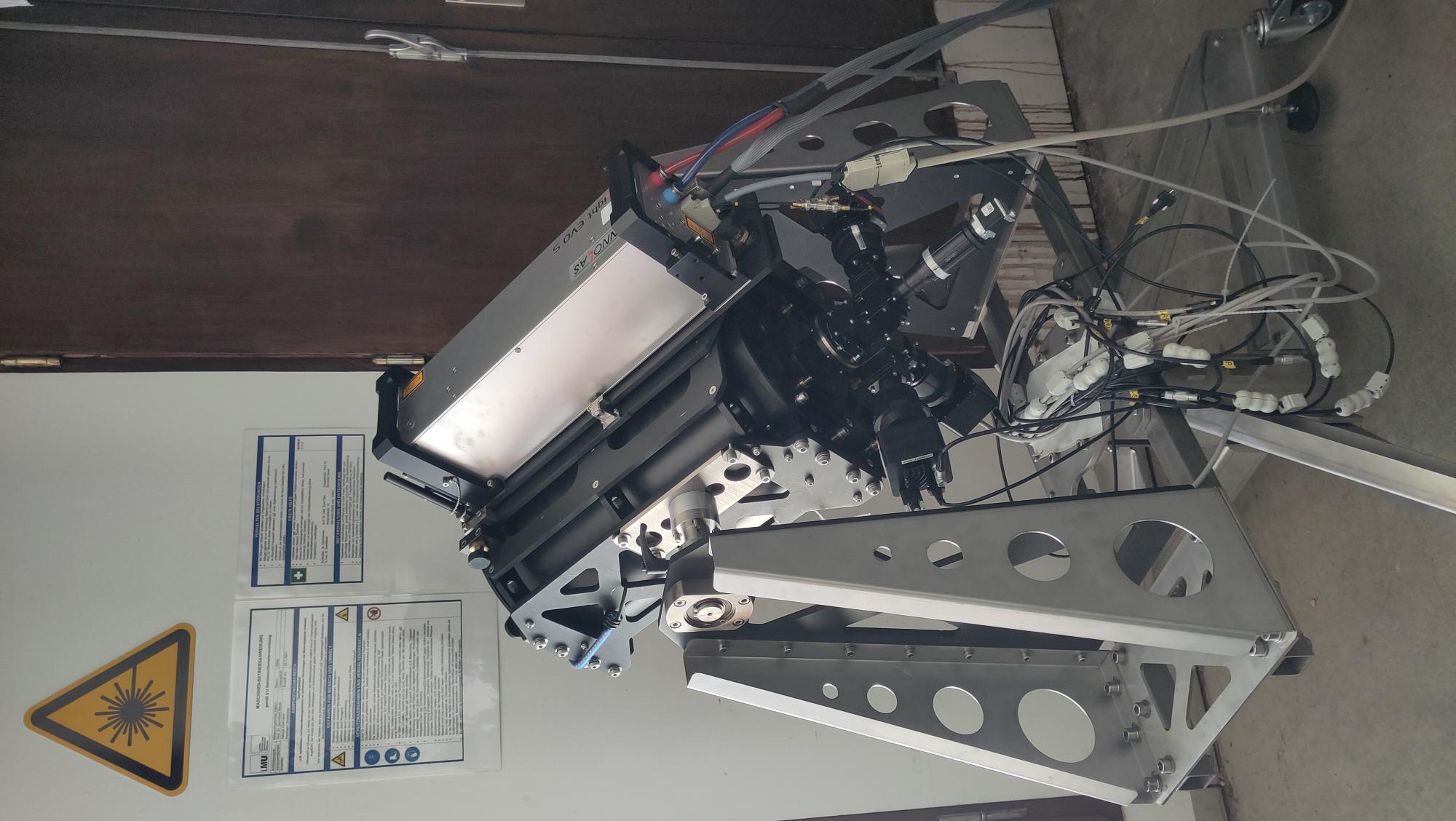
Figure 1. POLIS1064 at MIM. On the upper side 1064nm laser mounted on the 300mm telescope. The optical analyser is located below the telescope.
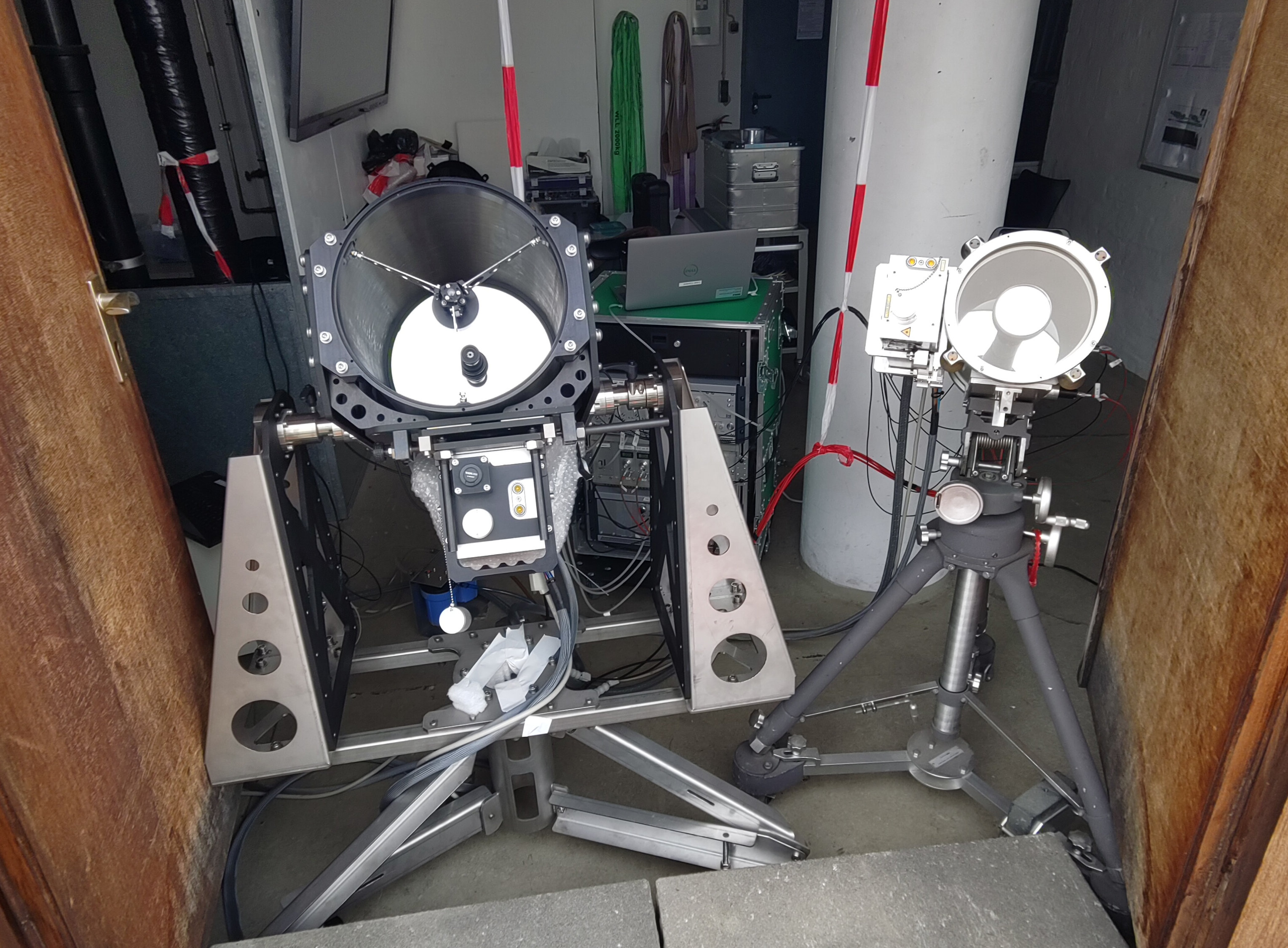
Figure 2. POLIS1064 and POLIS6 (together referred to as POLIS9) on roof of the Meteorological institute of Munich together with data recorders, power supply and control laptop in the back.
We are really happy to announce that our lidar family recently got a new member! Since early 2025 POLIS6, our 6-channel portable lidar system for 355 nm and 532 nm, got a sibling with 1064 nm measurement capabilities.
Our new POLIS1064 system (see Fig.1) is a portable scanning lidar with polarisation and rotational Raman channels at 1064 nm. POLIS1064 and POLIS6 are meant to operate as a single system which we call POLIS9 (see Fig.2) with 9 channels in total. POLIS9 is one of the reference lidar systems of ACTRIS. It is used to evaluate and improve the performance of the aerosol lidars of the ACTRIS National Facilities through direct lidar comparison campaigns when the data quality cannot be verified by means of the standard quality assurance tests. For that, time by time POLIS9 goes on bigger journeys through Europe in our measurement trailer (see. Fig.3)
POLIS1064 has been manufactured by Raymetrics SA. Its design minimizes polarisation cross-talks by avoiding any optics in the lidar transceiver which could introduce polarisation artifacts. POLIS1064 has a distance of full overlap less than 200 m, in accordance with ACTRIS requirements. An alignment camera is used to align the laser beam with respect to the optical axis. This setup allows for a stable, highly reliable, and easy controllable performance.
POLIS1064 features novel prototype avalanche photodiode detectors (APDs). The detectors and transient recorders are designed and manufactured by Licel GmbH. The goal of these prototypes was to revolutionize analog signal detection for lidar applications by overcoming long-lasting weaknesses such as low-frequency signal distortions, signal-induced distortions and susceptibility to ground-loops and electromagnetic interspersion.
POLIS1064 saw its first light in April 2025. During the first year of testing POLIS1064 was already operated during a direct lidar intercomparison campaign, which took place in October and November 2025 with the ACTRIS AHL system TONI in Garmisch-Partenkirchen. We are happy to announce that our data (see Fig.4) confirm a remarkable performance of the new system from 200 m up to 12 km. We are excited for future campaigns with our now bigger family.
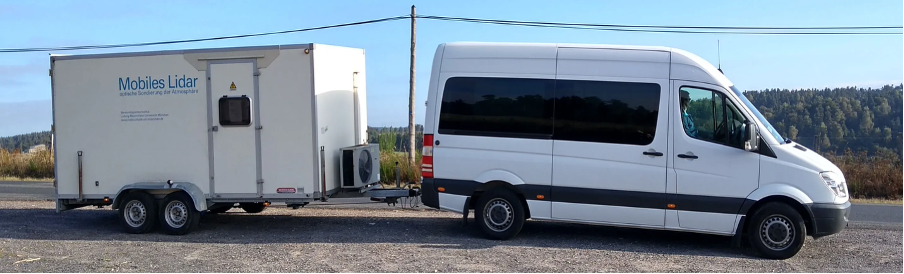
Figure 3. Van and trailer used for measurement campaigns.
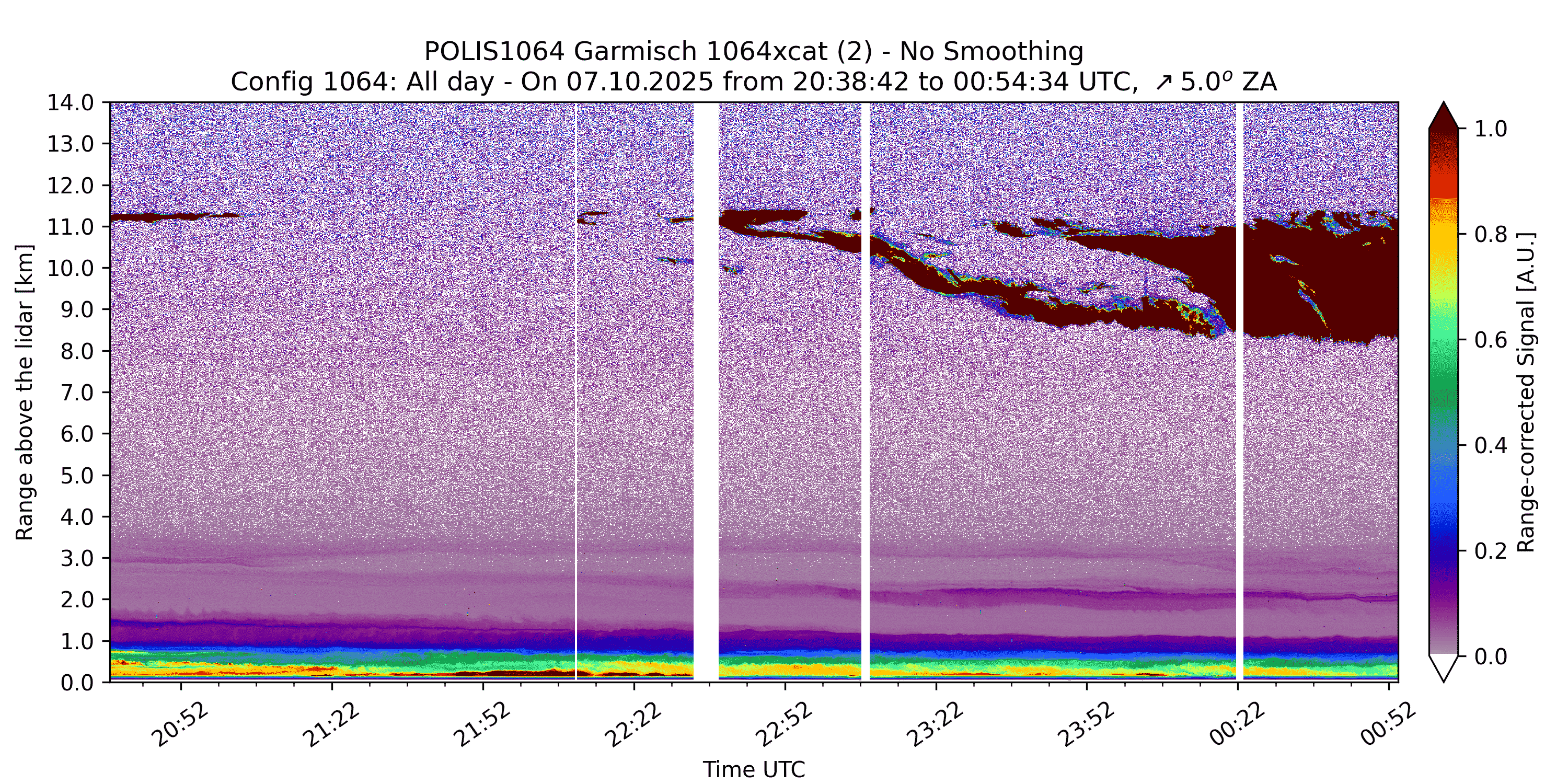
Figure 4. Quick look plot of the 1064 cross channel of POLIS1064 from the intercomparison campaign in Garmisch-Patenkirchen. The measurement was performed on 07.10.2025. We see the range corrected raw signal of the cross channel plotted over UTC time and along range above the lidar. Clearly visible are boundary layer aerosols, several elevated smoke layers up to 4km. Above 8 km cirrus clouds are visible. The white spaces along the time axis occur due to short interruptions of the measurement.